Every fan knows that college football does not lack rankings, but what it often lacks is clarity about what those rankings are actually trying to measure. The AP Poll, the Coaches Poll, playoff projections, betting markets and computer systems can all look at the same teams and arrive at different answers because they are not necessarily solving the same problem. The 135 Sports College Football Top 30 is built around one narrower question: who are the 30 best teams in college football right now? The live 135 Sports rankings are available throughout the season at 135sports.com/college-football-rankings, where the current board will serve as the public front door to the ranking system each week.
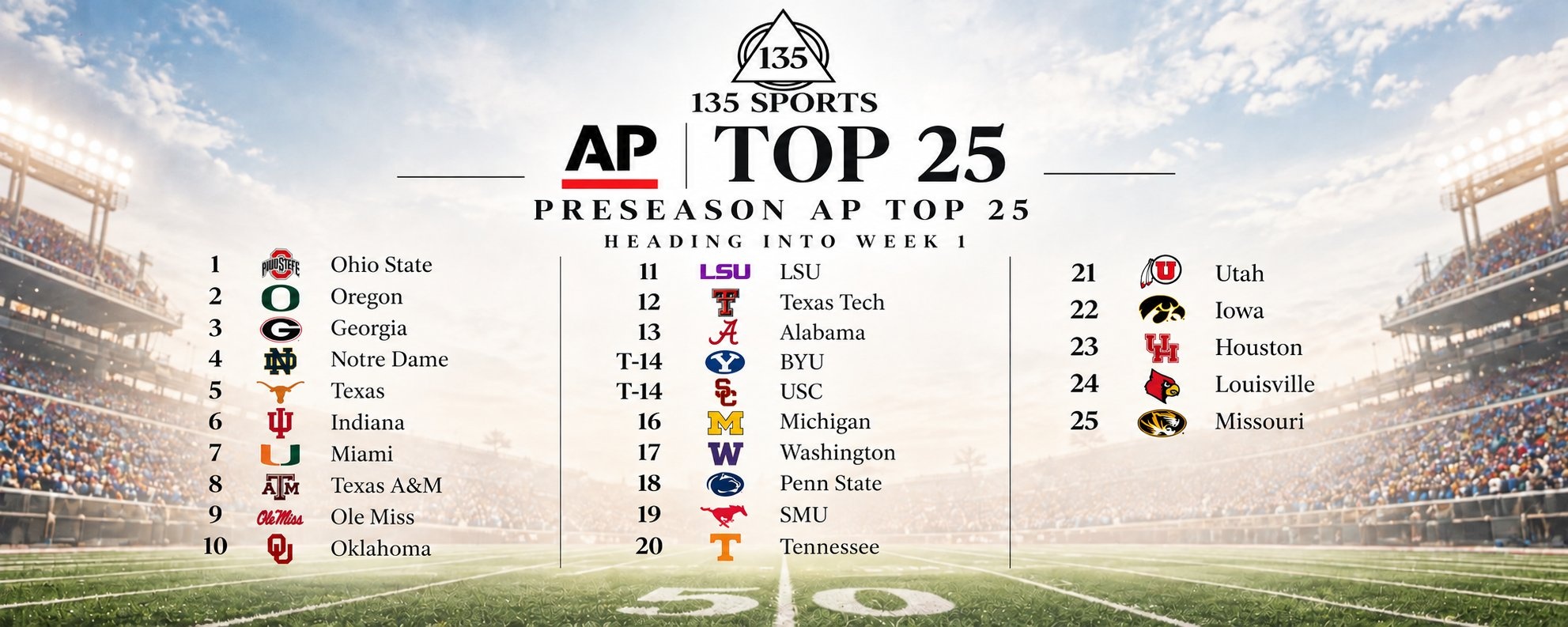
Before looking at where 135 differs, it helps to establish where the broader college football consensus began. Heading into Week 1, the AP Top 25 was still its preseason poll. Ohio State opened at No. 1, followed by Oregon, Georgia, Notre Dame and Texas, with BYU and USC tied at No. 14. That ranking represented the national media consensus before the first full week of games had an opportunity to materially change the picture.
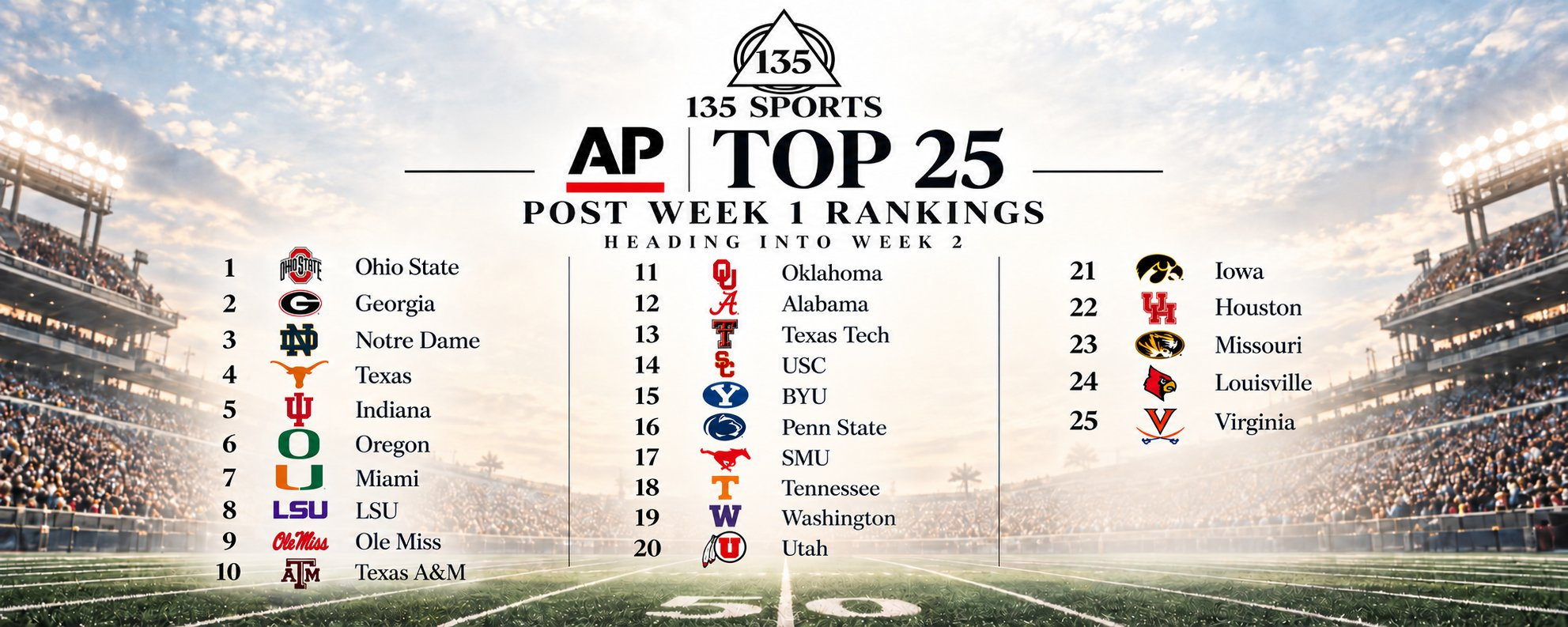
Week 1 immediately began changing that consensus. Ohio State remained No. 1 in the first regular season AP Poll, but Georgia moved to No. 2, Notre Dame to No. 3 and Texas to No. 4, while Oregon fell from No. 2 to No. 6 after its 34-27 win over Boise State. LSU made one of the largest moves after beating Clemson 51-10, climbing to No. 8, while Michigan fell completely out of the AP Top 25 after escaping Western Michigan 13-12. The poll did exactly what a weekly poll is supposed to do: absorb a new round of information and revise the national consensus.
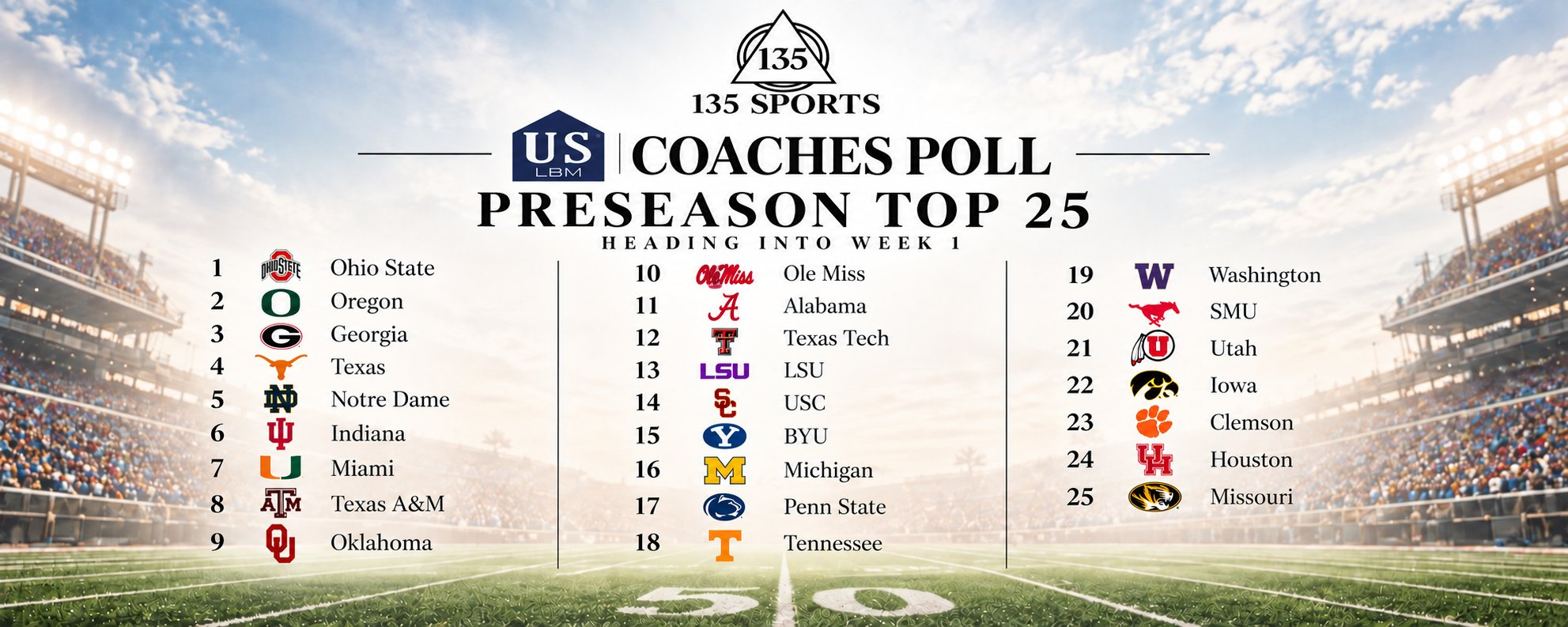
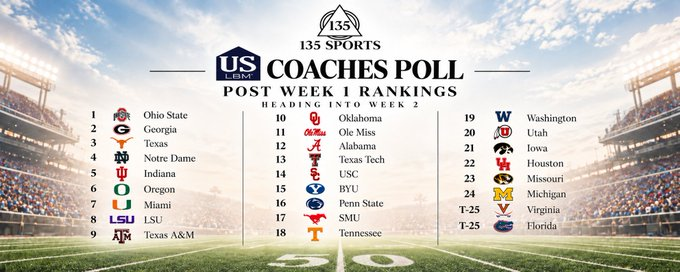
The Coaches Poll provides another useful benchmark because it begins from a similar national hierarchy while still producing meaningful differences of its own. Its preseason ranking also placed Ohio State, Oregon and Georgia in the top three, but Texas began at No. 4 ahead of Notre Dame at No. 5. Further down the board, Clemson appeared at No. 23, while USC and BYU were separated rather than tied. Those differences are useful because they remind us that even before the games begin, reasonable observers can disagree about the relative strength of teams using much of the same information.
After Week 1, the Coaches Poll also revised its view. Ohio State remained first, Georgia moved to second and Texas remained ahead of Notre Dame at Nos. 3 and 4. LSU rose to No. 8, matching the AP Poll, while Michigan remained ranked at No. 24 rather than falling out entirely. Virginia and Florida tied at No. 25. Looking at the AP and Coaches polls together gives us a useful map of consensus, but it also shows that there is no single universally accepted way to translate one week of football into an ordered view of the country.
That is where the 135 Sports ranking begins to separate itself. We are not trying to create a third version of the same poll or split the difference between existing rankings; the object is present team strength. We begin from a deliberate view of what each team is entering the season, then allow actual games to challenge that view through opponent and venue aware evidence. The early season starting point matters because one game is still only one game, but it is not sovereign. As the season produces more evidence, the football itself earns more authority. Eventually, the field has to win the argument.
Our first public 2026 board is therefore a reconstructed launch ranking after Week 1. It combines the starting team strength view with the football played through the opening week to produce the first public 135 Sports Top 30. There was no public 135 preseason ranking to move from, and we are not pretending one existed. This is the first public snapshot of the system.
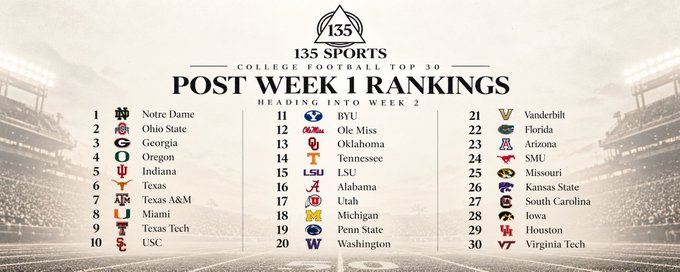
The first board begins with Notre Dame at No. 1, followed by Ohio State, Georgia, Oregon and Indiana. Some of those positions align closely with the major polls, while others do not. Texas A&M sits at No. 7 for 135, Texas Tech at No. 9 and Tennessee at No. 14, all higher than the broader polling consensus. LSU opens at No. 15 despite ranking No. 8 in both major polls, while Michigan remains No. 18 despite falling out of the AP Top 25. Those disagreements are not something we are trying to remove. They are where the ranking becomes most useful, because they force us to explain what evidence changed our view, what evidence merely confirmed it and where our interpretation differs from consensus.
The full live ranking, including the current board and future weekly updates, is available at 135sports.com/college-football-rankings. What follows explains how we think about the system itself, why a team can win and still open lower than its record might suggest, why blowouts do not always require a dramatic revaluation, and why disagreement with the AP Poll, Coaches Poll or betting markets can be informative without automatically requiring us to change the answer.
How 135 Sports Ranks College Football
A different way to answer a simple question: Who are the 30 best teams in the country right now?
College football has never suffered from a shortage of rankings. Before the season begins, teams have already been ordered by voters, projection systems, sportsbooks, computer models and nearly every major media outlet in the country. Once the games start, those rankings begin moving almost immediately. A team wins by forty and jumps six spots, another survives an ugly afternoon and falls despite remaining undefeated, and a highly regarded program can lose once and disappear from a ballot while another team with a cleaner record moves ahead of it. Most of those rankings are useful in their own way, but they are often answering different questions while presenting their answers as though they were interchangeable.
The 135 Sports College Football Top 30 begins with one governing question: if the 30 best teams in college football had to be ordered today, based on everything we know right now, what is the correct order? That is not necessarily the same thing as asking which teams have built the best résumés. It is not the same as determining which teams are most deserving of playoff bids, and it is not exactly the same as asking which teams would be favored by sportsbooks tomorrow. Those questions can produce different answers without any of them being irrational. Our ranking is built around present team strength, which means everything we use ultimately has to help answer the same underlying question: how good is this football team right now?
A 1-0 record does not tell us enough by itself, and neither does a 56 point win. Recruiting talent alone is not enough, last season’s record is not enough, a quarterback’s reputation is not enough, and a coach’s résumé is not enough. All of those things can matter, but they matter because they provide evidence about the strength of the team that actually exists today. The purpose of the ranking is not to reward one type of evidence simply because it is easy to observe. It is to bring the relevant evidence into one disciplined view of the team and then allow that view to change when the field gives us a reason to change it.
Every ranking system starts the season with a prior belief about teams whether it acknowledges that fact or not. If Georgia is ranked ahead of a rebuilding program before either team has played a snap, information from before the season is already being used. A voter may call that intuition, experience or common sense, while a model may formalize the same process. Nobody enters Week 1 believing all 138 FBS teams are equally strong, and nobody who follows the sport closely behaves as though they do. We wanted our starting point to be deliberate rather than implicit.
Before live football begins to take over the ranking, 135 establishes a team strength baseline using information that describes the team entering the season. That includes broad areas such as roster quality and depth, offensive outlook, returning production and continuity, recent demonstrated performance, and the stability and quality of the program environment surrounding the roster. We are intentionally not publishing the exact internal construction of that baseline. The purpose of explaining the methodology publicly is to show how the ranking thinks and what kinds of evidence matter, not to publish enough of the machinery for every internal calculation to be reconstructed from the outside.
More importantly, that starting view is not a preseason prediction that we spend the next four months trying to defend. It is simply the most informed state we can establish before current season evidence exists. That distinction matters because early season football contains very little live information. If a team enters September with an elite roster, proven coaching, meaningful continuity and a strong recent performance base, one strange quarter should not erase everything known about it. At the same time, preseason information cannot remain sovereign forever. If a team keeps playing below what its strength implied, eventually the field has to win the argument.
Once games begin, the question is no longer simply whether a team won. We want to know what the performance taught us relative to what we believed before kickoff. Opponent strength matters, venue matters, and the quality of the performance relative to the circumstances matters. A 28 point win against a credible opponent tells us something different from a 28 point win against a team that was badly overmatched before the game began. A three point road win over a strong team can provide more useful information than a comfortable home win over a weak one. A highly ranked team can win and still provide evidence that it is slightly weaker than we thought, just as a lower ranked team can sometimes lose while showing that it belongs higher than it did before.
That distinction is especially important in college football because schedules are profoundly uneven. Some teams open against national contenders while others spend September playing opponents they are expected to overwhelm. Home fields matter, neutral sites matter, matchups matter, and the same final margin can mean very different things depending on the teams involved. If a ranking is supposed to estimate present strength, context cannot be optional. The scoreboard tells us what happened, while the ranking has to ask what we learned from what happened.
The first few weeks of a season are also when overreaction is easiest. A team looks spectacular on national television and suddenly becomes everyone’s championship favorite, while another sleepwalks through an opener and gets treated as though its roster, coaching staff and previous body of evidence disappeared overnight. Sometimes those reactions turn out to be correct, but often they are simply too aggressive. Our approach is designed to let live football earn more authority as the sample grows rather than handing complete control of the ranking to the most recent Saturday.
The information known entering the season matters most when there is almost nothing else to work with. As games accumulate, observed football matters increasingly more. That transition is intentional because the ranking should not remain anchored to August forever, but it also should not pretend September 5 contains the same amount of information as November 15. By the middle of the season, teams have played enough opponents in enough different environments that the live evidence should be doing most of the work. The goal is to move from an informed starting state toward observed reality at the pace the evidence justifies.
That is why our first 2026 ranking begins after Week 1 instead of with a public preseason Top 30. We established the starting team strength view first, then incorporated what the opening games told us before publishing the first board. The result is a reconstructed launch ranking, a first public snapshot built from the starting team strength view and the football played through Week 1. It gives us a public starting point grounded in actual games without pretending we published a preseason ranking that never existed.
Notre Dame is the clearest example of how that process can change the top of the board. The Irish already entered the season as one of the strongest teams in the country, so Week 1 did not need to manufacture a case for them being elite. What changed was the quality of the new evidence. Notre Dame beat Wisconsin 41-13 at a neutral site, and that result carried more information than an elite program simply overwhelming a badly outmatched opponent. It strengthened an already exceptional profile enough to move Notre Dame to No. 1 in our first public ranking.
Ohio State sits at No. 2 after beating Ball State 56-3. There is nothing negative about winning by 53 points, and the Buckeyes remain one of the most talented and complete teams in the country. The difference is that there was also very little reason to expect Ohio State to struggle in that matchup. The result largely confirmed what was already known rather than revealing something dramatically new. Notre Dame moved ahead because its opening performance added more meaningful evidence, not because Ohio State disappointed.
Georgia is No. 3 for much the same reason. The Bulldogs demolished Tennessee State 63-3, exactly the kind of result an elite Georgia team should produce in that situation. The performance gave us no reason to lower Georgia, but it also provided less new information than a dominant performance against a stronger opponent. Georgia remains near the top because the underlying profile is still exceptional, and one week of football did nothing to materially weaken it. Confirmation matters, but confirmation is different from discovery.
Oregon is where the difference between winning and strengthening your valuation becomes more obvious. The Ducks entered the launch process with perhaps the most complete profile in the country, and they still beat Boise State 34-27. Boise State is not a meaningless opponent, so the result should not be treated as a disaster or anything close to one. At the same time, a seven point home win was less convincing than Oregon’s starting strength suggested it should be. Oregon remains firmly in the elite tier, but the new evidence was weaker than the evidence produced by the teams that moved ahead, which is why the Ducks open our first public board at No. 4.
LSU provides the opposite example. The Tigers destroyed Clemson 51-10 in one of the strongest performances of the opening week, and our starting view of LSU was more conservative than the public consensus. That result created substantial positive pressure on our starting view of LSU and moved the Tigers to No. 15 in the first public ranking. The AP and Coaches polls reacted much more aggressively and moved LSU to No. 8, which creates one of the more interesting disagreements on the board. The public polls effectively decided that the Clemson performance justified a much larger revision, while our approach moved LSU meaningfully but still allowed one game to sit alongside the larger body of information that existed before kickoff.
If LSU continues to play like the team that appeared against Clemson, the ranking will keep moving. The system does not have to decide after one Saturday that everything it previously believed was wrong. That is one of the benefits of treating rankings as an updating process rather than a weekly reset. Strong evidence should matter, and extraordinary evidence should matter more, but the size of the adjustment should still reflect how much information actually exists.
Michigan demonstrates the other side of that discipline. The Wolverines beat Western Michigan 13-12, so the record says 1-0, but the performance was still weak evidence relative to the strength Michigan carried into the game. A one point escape against an opponent Michigan was expected to control has to matter if the ranking is actually measuring current team strength. That performance weakened Michigan’s starting evaluation enough for the Wolverines to open at No. 18, while the AP Poll reacted even more aggressively and dropped them from the Top 25 entirely. Both rankings saw the same game, and they simply revised their beliefs at different speeds.
The traditional instinct that winners should rise and losers should fall sounds intuitive until you try to apply it consistently across college football. Imagine one of the best teams in the country beating one of the weakest teams on its schedule by seven while a team ranked fifteen spots lower wins convincingly on the road against a strong opponent. Treating both results as equally positive simply because both teams became 1-0 would discard most of the useful information contained in the games. The first team may have won while giving us evidence that its original valuation was too high, while the second may have revealed something important that was not visible before kickoff.
That is why we are comfortable with a team winning and still opening lower than a simple résumé view might suggest. Houston beat Oregon State 33-20 and opens toward the bottom of our Top 30, while SMU won 27-24 at Florida State and likewise opens lower than an undefeated record alone might imply. Neither performance is being treated as a loss, and neither result means the teams suddenly became poor. The issue is that both performances were somewhat weaker than the strength implied by our starting evaluations while other teams around them produced stronger evidence. Rankings are relative, which means a team’s position can differ meaningfully from what its record alone might suggest because every team on the board is being evaluated at the same time.
The same principle applies to enormous wins. Ohio State’s 56-3 victory was visually overwhelming, but the matchup was supposed to be overwhelming. Kansas State beating Nicholls 71-3 is much better than struggling against Nicholls, but the result does not suddenly prove Kansas State is stronger than teams that entered with substantially better profiles and faced more informative competition. A useful ranking has to distinguish between a result that confirms an existing belief and a result that forces us to discover something new about a team. Both matter, but they should not automatically have the same effect.
We publish the AP and Coaches rankings alongside the 135 Top 30 because those polls are useful external benchmarks. They aggregate the judgment of people who follow the sport closely and give readers an immediate picture of the prevailing consensus. They also make our disagreements visible, which is important because a ranking is much more useful when people can see where its view differs from the broader conversation. We do not need those differences to disappear for the system to be working.
Texas Tech is No. 9 for 135 and No. 13 in both major polls. Texas A&M is No. 7 for us and lower in the public consensus, while Tennessee is No. 14 despite sitting farther down in the traditional rankings. LSU moves in the opposite direction, sitting at No. 15 for 135 and No. 8 in both polls. Michigan remains No. 18 for us despite falling out of the AP Top 25. Those differences are not errors that need to be averaged away. They are places where two different approaches to interpreting the same sport have reached different conclusions.
Agreement with consensus is not the objective, and disagreement is not proof that 135 is automatically smarter than everyone else. The value lies in being able to understand why the difference exists. Sometimes we began with a stronger view of a team than consensus did, while other times the polls respond faster to a single result. Our ranking may eventually move toward the public view as more evidence arrives, and consensus may move toward ours. What matters is that the governing question does not change depending on which answer looks better that week.
We tend to think about the ranking more like a valuation process than a weekly ballot. A team enters with a view based on the information available, games produce new information, and that information either confirms the existing valuation or changes it. Most performances should produce modest revisions, while occasionally a result is powerful enough to force a larger repricing. That movement then happens relative to every other team being evaluated at the same time, which is why rankings should never be interpreted as if the numerical distance between every adjacent position were identical.
A team moving four spots is not necessarily four units better than it was a week earlier. Its own underlying evaluation may have changed only slightly while several nearby teams moved more sharply in the opposite direction. The distance between No. 4 and No. 5 is not necessarily the same as the distance between No. 24 and No. 25, because rankings are ordinal rather than a statement that every slot represents the same amount of team strength. Movement tells you where a team now sits relative to the field. It does not, by itself, tell you the size of the underlying change.
There is still a role for human review because the answer to flawed subjective voting is not blind obedience to a spreadsheet. Models see what they are designed to see, while football contains injuries, quarterback changes, unusual venue circumstances, incomplete information and abrupt changes in team state that may not immediately fit neatly into a structured system. Before publication, we review the ranking for those situations. The purpose of that review is not to replace the analytical process with opinion, but to make sure the analytical result is being interpreted in the correct football context.
The constraint is that judgment cannot become an invisible escape hatch. A disagreement with the analytical output does not silently rewrite the analytical output, and a team should not be moved simply because somebody had a stronger feeling about it on Sunday night. If the final published order is changed, the adjustment needs to be deliberate and explainable. Human review should function as governance over the process, not as permission to abandon the process whenever it produces an uncomfortable answer.
We are extending the same philosophy to external evidence. The AP and Coaches polls give us useful consensus benchmarks, while betting markets offer something different because point spreads represent an economically constrained view of relative team strength. Unlike a ballot, those prices are formed in markets where participants can commit capital against disagreement, which makes them potentially valuable as an independent reasonableness check on our own view.
If 135 believes a team should be materially stronger than the betting market appears to believe, we should want to know why. The market may have injury information we have not incorporated, our view of the opponent may be stale, or a team may have changed more quickly than a deliberately conservative early season system can recognize. It is also possible that no defect exists and 135 simply disagrees with the market. The point of the check is not to eliminate disagreement. It is to make sure we understand what the disagreement is telling us.
What we will not do is quietly mix Vegas into the ranking and then describe the result as independent. External markets are checks, not ingredients. If a market disagreement causes us to investigate and discover an actual data problem, we should correct the problem through the proper process. When no problem exists, the disagreement itself becomes useful information. A system becomes much less interesting when every external disagreement is immediately averaged back into consensus, because at that point independence exists mostly as branding.
We would rather publish a ranking that can explain why it is different than engineer one designed to make disagreement disappear. That applies to sportsbooks, traditional polls and any other external benchmark we use to challenge the result. The purpose of a control is to make us investigate where our assumptions may be wrong, not to quietly import somebody else’s answer into ours. If the process survives that challenge, the ranking should remain ours.
The first few weeks of the season will still contain meaningful preseason information because there simply are not enough games yet for the field to answer every question. By midseason, the balance should look very different; teams will have accumulated multiple games against different levels of opposition in different environments, and the ranking should become increasingly governed by what they have actually demonstrated. Some teams will rise quickly, others will decline more slowly because their broader profiles remain strong, and some teams will compile attractive records without producing evidence strong enough to move as high as the public expects.
Every week, we will publish the Top 30 with each team’s record, previous 135 ranking, movement, AP ranking and Coaches ranking. The accompanying analysis will focus on the teams where something meaningful changed, whether because of an exceptional performance, a disappointing one, a shift in the state of the team or movement elsewhere on the board. The rankings should become more informative as the season develops because the football itself will gradually replace the assumptions that were necessary before enough football existed.
College football will spend the season debating who deserves to make the playoff, whose résumé is strongest, which conference is best and which team has accumulated the most impressive wins. Those are worthwhile arguments, and they are part of what makes the sport so compelling. We are trying to answer something narrower and, in its own way, harder: who are the 30 best teams in college football right now? Our first answer begins with Notre Dame, Ohio State, Georgia, Oregon and Indiana. That answer will change over the course of the season, and it is supposed to. Every week, the field gets another opportunity to change it.
135 Sports College Football Top 30 Heading Into Week 2
The first 135 Sports College Football Top 30 is our attempt to turn the methodology into an actual ordered view of the sport. What follows is the reasoning behind each team’s placement heading into Week 2, with the emphasis on what the opening week added to or challenged in our starting view. These are not mechanical readouts of the model and they are not résumé summaries. They are the public explanation for why each team sits where it does today, using the same framework described above: present team strength, quality of evidence, context, and the degree to which the field has changed what we thought we knew.
1. Notre Dame
Notre Dame takes the top spot because it paired one of the strongest starting profiles in the country with one of the most meaningful Week 1 performances among the elite teams. The Irish beat Wisconsin 41-13 at a neutral site, not simply winning comfortably but doing so against an opponent strong enough to make the result informative. That matters more to us than running up a score against an overmatched opponent. Notre Dame entered the season with the roster quality, offensive ceiling, continuity and recent program performance to belong in the top tier already, and Week 1 gave us enough additional evidence for the Irish to open at No. 1.
2. Ohio State
Ohio State opens at No. 2 because nothing in Week 1 gave us a reason to materially change an already elite view of the Buckeyes. A 56-3 win over Ball State was dominant, but dominance was also the expectation given the enormous talent gap between the teams. Ohio State still owns perhaps the best raw roster profile in the country, combines that talent with an established championship level regime, and has very few structural weaknesses. The Buckeyes are No. 2 not because anything went wrong, but because Notre Dame produced a more informative positive signal against a substantially stronger opponent.
3. Georgia
Georgia remains firmly in the championship tier after taking care of Tennessee State 63-3. Like Ohio State, the Bulldogs were expected to dominate that matchup, so the result mostly confirmed rather than transformed our view of the team. Georgia continues to benefit from elite roster strength, recruiting depth, coaching stability and one of the strongest sustained program infrastructures in the sport. There simply was not enough new information in Week 1 to justify a major revaluation, which puts Georgia at No. 3 on our first public board.
4. Oregon
Oregon entered the season with perhaps the most complete profile in the country, but the 34-27 win over Boise State was weaker than what we expected from a team of Oregon’s caliber. Boise State is a respectable opponent, so the result is not remotely disqualifying, but a seven point home win did provide meaningful negative evidence relative to Oregon’s preseason strength assessment. The Ducks remain one of the most talented and offensively dangerous teams in the country. Oregon remains firmly in the elite tier, but the new evidence was weaker than the evidence produced by the three teams ahead of the Ducks on our first public board.
5. Indiana
Indiana opens at No. 5 after a convincing 52-16 win over North Texas. The Hoosiers entered the season with an unusually strong combination of recent demonstrated performance, continuity, offensive quality and program stability, so their placement was never based on one week of hype. Week 1 did nothing to weaken that case. The opponent was not strong enough for the result to generate a major revaluation, but Indiana handled the game exactly the way a legitimate top five team should.
6. Texas
Texas is one of the most talented teams in college football and reinforced that standing with a 59-7 win over Texas State. The Longhorns entered with elite underlying roster strength and a high end offensive profile, and Week 1 added another dominant performance without exposing any obvious reason to downgrade them. The reason Texas sits sixth rather than in the top three is primarily comparative: several teams above them entered with slightly stronger combinations of continuity, recent performance and overall starting profile. This is still a national title caliber team in our view.
7. Texas A&M
Texas A&M is one of the places where 135 is more bullish than the traditional polls. The Aggies entered with a strong starting profile built around high end talent, program resources and underlying team quality, and a 50-0 win over Missouri State preserved that assessment. The opponent limits how much we can learn from the result, but A&M did exactly what an elite team should do against an inferior one. We are not waiting for the public polls to validate the roster and structural strength that were already present before kickoff.
8. Miami
Miami opens at No. 8 after an impressive 45-6 road win at Stanford. The Hurricanes entered with one of the stronger overall profiles in the country, and this was meaningful positive evidence because it came away from home and against an FBS opponent rather than as a routine home blowout. Miami’s combination of talent, offensive upside and increasingly credible program stability makes the ceiling extremely high. Week 1 strengthened rather than merely confirmed the case.
9. Texas Tech
Texas Tech opens inside our top ten after a 33-10 win over Abilene Christian that was less overwhelming than some of the other scores around the country. Our ranking of Texas Tech is based on the broader team profile, not on chasing one Saturday’s margin. The Red Raiders entered with excellent underlying strength, significant offensive potential and a roster we believe is stronger than the consensus ranking suggests. Week 1 was not strong enough to justify an even higher placement, but it also was not meaningful enough to erase the reasons we valued Texas Tech so highly entering the season.
10. USC
USC rounds out the top ten after opening 2-0, beating San Jose State 42-26 and then shutting out Fresno State 39-0. The two game sample is useful because it gives us more evidence than most teams have at this point, and the second performance in particular was encouraging. USC entered with a strong offensive outlook and substantial underlying talent, but the opening win over San Jose State was not clean enough to generate a major upward revaluation. Taken together, the first two games largely validate USC as a top ten caliber team without yet demanding placement in the very top tier.
11. BYU
BYU sits just outside the top ten after dismantling Utah Tech 63-7. The Cougars entered with a strong combination of continuity, recent performance and program stability, which gave them a higher starting evaluation than much of the public consensus. Week 1 reinforced that strength, even if the opponent was too overmatched for the result to tell us much about BYU’s ceiling. The overall profile is strong enough to place the Cougars ahead of several more traditionally prominent programs.
12. Ole Miss
Ole Miss opens at No. 12 after beating Louisville 41-38 at a neutral site. The win matters because Louisville is a credible opponent, but the closeness of the game was softer than what we expected from Ole Miss given the difference between the teams entering the matchup. That creates a mixed signal: there is value in beating a solid opponent, but the performance was not dominant enough to justify a more aggressive valuation. Ole Miss ranks highly because the underlying offensive strength and broader program profile are still substantial.
13. Oklahoma
Oklahoma handled UTEP 51-0 and opens firmly in the second tier of our rankings. The Sooners entered with a strong roster, high end underlying team strength and enough program stability to carry a strong starting evaluation. A complete demolition of UTEP is what we wanted to see, but the matchup itself limits how much new information the result provides. The performance supports Oklahoma at No. 13 without forcing a more aggressive Week 1 revaluation.
14. Tennessee
Tennessee opens at No. 14 after a 56-9 win over Furman. The Volunteers possess one of the higher offensive ceilings in the country and entered with enough established program quality to deserve significant respect before playing a game. Week 1 confirmed that they can overwhelm inferior competition but did not offer the kind of opponent that would allow us to substantially raise their valuation. Tennessee remains a dangerous team with a path into the top ten if the same offensive quality translates against stronger competition.
15. LSU
LSU produced one of the most important Week 1 revaluations. The Tigers destroyed Clemson 51-10, producing one of the strongest positive pieces of evidence on the entire board. Our starting assessment of LSU was more cautious than the traditional polls, so one game does not completely erase that starting view, but this result forced a meaningful upward adjustment. No team in this part of the rankings has a more obvious opportunity to climb quickly if Week 1 was the beginning of a genuine change in team quality rather than an isolated performance.
16. Alabama
Alabama opens at No. 16 after beating East Carolina 48-10. The Tide still possess elite talent and a program infrastructure that gives them enormous upside, but our starting assessment was more conservative than the traditional polls because the total profile did not grade quite as strongly as Alabama’s reputation alone might imply. Week 1 was encouraging and reinforced the talent level, but East Carolina was not the kind of opponent that should cause us to aggressively reprice the team. Alabama has every opportunity to climb, but we want the evidence first.
17. Utah
Utah opens at No. 17 after overwhelming Idaho 66-14. The Utes entered with a strong program foundation, proven coaching stability and a roster capable of competing at a high level, so this was not a surprise emergence. What Week 1 did was reinforce the idea that Utah remains a disciplined, high floor team with enough offensive strength to punish inferior competition. The opponent keeps us from overreacting, but the overall case is stronger after Week 1 than it was before kickoff.
18. Michigan
Michigan opens at No. 18 after escaping Western Michigan 13-12 in one of the weakest performances by a highly regarded team in Week 1. The Wolverines entered with enough talent and program strength to carry a strong starting evaluation, but barely surviving an opponent they were expected to control is meaningful evidence. We are not dropping Michigan from consideration as a strong team because one poor game does not erase the underlying roster or institutional strength. But if the purpose of the ranking is to identify the best teams right now, the Week 1 performance has to matter.
19. Penn State
Penn State opens at No. 19 after shutting out Marshall 45-0. The Nittany Lions entered as a strong team structurally, with good roster quality and a proven program base, but their starting profile was not quite strong enough to place them alongside the true national title tier. Week 1 was exactly what Penn State needed to do and provided a modest positive signal. The next step is showing the same level of control against stronger opposition.
20. Washington
Washington opens at No. 20 after beating Washington State 24-10. The Huskies entered with a strong roster and program profile, but the margin was a little softer than what our starting view suggested should occur against Washington State. That is not a major concern, and a comfortable win still carries value. It simply was not strong enough evidence to place Washington ahead of teams that produced more informative Week 1 performances.
21. Vanderbilt
Vanderbilt is one of the more unconventional teams in our Top 30 because our starting assessment was substantially higher than the public consensus. The Commodores beat Austin Peay 28-9, which was a win but not an overwhelming enough performance to materially strengthen that case. Their ranking is therefore still driven largely by the broader team profile we liked entering the season rather than a dramatic Week 1 statement. Vanderbilt now needs stronger opponents to validate whether that preseason optimism was warranted.
22. Florida
Florida opens at No. 22 after beating FAU 66-21. The Gators already possessed the raw talent and program scale to be dangerous, but their starting evaluation carried more uncertainty than some of the teams above them. Week 1 delivered a clear positive signal because Florida did not merely win; it imposed itself offensively and produced the kind of margin expected from a team trying to reestablish itself nationally. The Gators still have more to prove, but the early evidence is encouraging.
23. Arizona
Arizona opens at No. 23 after a 35-7 win over Northern Arizona. The Wildcats entered with a credible team strength profile and enough offensive and roster quality to merit serious Top 30 consideration. Week 1 did not dramatically change that assessment because of the opponent, but Arizona handled its business comfortably and avoided giving us a reason to downgrade our starting view. For now, the Wildcats remain a strong but still relatively untested team in this range.
24. SMU
SMU opens at No. 24 after winning 27-24 at Florida State, but the performance was weaker than the margin we expected from the Mustangs entering the matchup. That distinction matters: winning on the road is valuable, but a team can win and still provide slightly negative evidence relative to its prior strength assessment. SMU remains in the Top 25 because its starting profile was strong and the road victory still carries real value. The placement reflects performance relative to expectation, not a judgment that the win itself was somehow bad.
25. Missouri
Missouri opens at No. 25 after beating Arkansas Pine Bluff 54-14. The Tigers have enough roster quality and recent program credibility to belong around the Top 25, but Week 1 offered little new information because the matchup was heavily tilted from the outset. Missouri did what it was supposed to do and avoided any negative signal. We remain conservative until we see the Tigers against opposition capable of testing the underlying profile.
26. Kansas State
Kansas State lands at No. 26 after crushing Nicholls 71-3. The Wildcats entered the season with a solid program foundation and a starting evaluation close to the Top 25 threshold, and Week 1 reinforced that assessment emphatically. The opponent prevents us from treating the result as transformational, but there is still value in completely eliminating uncertainty against a team you are supposed to dominate. Kansas State is close enough to the Top 25 that another strong performance against better competition could push the Wildcats higher quickly.
27. South Carolina
South Carolina opens at No. 27 after a 57-0 shutout of Kent State. The Gamecocks entered the season with a credible overall profile but not enough separation from the teams around the Top 30 cutoff. Week 1 provided a clean positive signal, with South Carolina completely controlling an FBS opponent and avoiding the kind of sloppiness that often shows up early in the season. The result is not enough to place them dramatically higher, but it strengthens their claim to a Top 30 position.
28. Iowa
Iowa opens at No. 28 after beating Northern Illinois 40-0 and producing a stronger Week 1 result than many people might have expected from the Hawkeyes. The performance improves our view, but Iowa began from a lower offensive and overall team strength position than many of the teams above it, which limits how high one game should carry the ranking. The shutout demonstrates the kind of floor Iowa has traditionally been capable of creating through defense and control. To climb materially higher, we need evidence that the offense can sustain that level against stronger opponents.
29. Houston
Houston opens at No. 29 after beating Oregon State 33-20. The result was less convincing than our starting evaluation suggested it should be, but winning by 13 preserved the broader case for Houston as a Top 30 team. Several teams around the Cougars produced stronger Week 1 evidence, which matters in a relative ranking. Houston therefore opens near the bottom of the board despite starting the season with enough underlying strength to remain firmly in the conversation.
30. Virginia Tech
Virginia Tech enters the public Top 30 after obliterating VMI 73-3. The Hokies carried a starting evaluation close to the public cutoff, so the result did not require a wholesale revaluation for Virginia Tech to earn the final position. Week 1 gave them exactly the kind of dominant performance that can separate two closely rated teams near the cutoff. The opponent limits how much we should extrapolate, but Virginia Tech did everything possible within the matchup to strengthen its case and earns the final position heading into Week 2.
Conclusion
This first 135 Sports College Football Top 30 is a starting point, not a verdict on the season. The value of the ranking will come from watching it change as the evidence becomes richer, the schedules become more demanding and the field begins answering questions that could only be estimated in August. Some teams will confirm what we believed about them, some will force us to reconsider quickly, and others will expose disagreements between 135, the traditional polls and the broader market that are worth understanding rather than smoothing away. The governing question will remain the same every week: who are the 30 best teams in college football right now? Follow the current board and every weekly update at 135sports.com/college-football-rankings. The rankings will change because they are supposed to. Every week, the field gets another opportunity to change the answer.
Disclosure
Disclosure: The 135 Sports College Football Top 30 is an independent editorial and analytical ranking produced by 135 Sports. It is not affiliated with, sponsored by, endorsed by or produced in partnership with the NCAA, the College Football Playoff, the Associated Press, the US LBM Coaches Poll, any conference, university, athletic department, sportsbook or other organization referenced in this article. Team names, logos and other trademarks belong to their respective owners and are referenced for identification and editorial commentary. Scores, schedules, poll positions and other public football information are drawn from publicly available sources and are believed accurate as of publication. The rankings represent 135 Sports’ assessment of present team strength and may change as new information becomes available. They are not intended as gambling, financial or investment advice. For the live rankings and future updates, visit 135sports.com or go directly to 135sports.com/college-football-rankings.



Explore 135 Sports: Weekly Rankings · CFB Top 30